Penetrating damp treatment, causes and symptoms
Penetrating damp is the process of moisture moving from the exterior wall of a building to the interior. It occurs when outside moisture like wind-driven rain impacts a building’s wall.
Building materials like brick are porous. They soak up rain to saturate the wall with penetrating damp. Read on or choose from the contents below to find out more.
- What is penetrating damp?
- Penetrating damp causes
- Penetrating damp signs on external walls
- Penetrating damp signs on internal walls
- Cavity walls vs solid walls
- How to prevent penetrating damp
- How to treat penetrating damp internally
- How to treat penetrating damp externally
- Penetrating damp cost to fix
- Free penetrating damp CPD webinar
What is Penetrating Damp?

Penetrating damp is the process of moisture moving from the exterior wall of a building to the interior. It occurs when outside moisture like wind-driven rain impacts a building’s wall. Building materials like brick are porous. They soak up rain to saturate the wall with penetrating damp.
Rain penetration into masonry can occur in buildings of all ages. At its most obvious, it penetrates the wall and displays as a damp patch on the internal wall. This causes discolouration, paint and wallpaper peeling and flaking.
Even if it does not penetrate entirely through a wall, rainwater penetration can be damaging to a property. Wind-driven rain in masonry can cause moss growth, increased heat loss and frost damage.
Water soaks through the exterior wall, where it travels through to the interior walls. There, moisture manifests as wet spots on the wall. These patches of penetrating damp damage wallpaper, plaster and the walls themselves.
The resulting damp environment causes spores in the air to settle. Mould and mildew begin to grow.
Brick and masonry substrates are especially susceptible to penetrating damp. This is due to their interior structure which gives them sponge-like properties of moisture absorption.
Rain penetration is not a problem that is restricted to single-skin walls. Poorly installed wall-ties or cavity wall insulation can provide a pathway for rain penetration to track through cavity walls.

In many cases, rain penetration is caused by poorly designed or maintained building details (e.g. blocked downpipes or leaking gutters) causing large amounts of rainwater to flow over a small section of masonry. In these cases, the penetrating damp can usually be cured by rectifying the defect.
Roof damage can let in moisture, causing damp to take hold. Common things to look for on roofs include damaged flashing and pointing, as well as cracked or missing tiles.
The drainage system is also a point of common failure. If exterior drains become clogged, rainwater can collect against the brickwork – leading to hot spots of penetrating damp.
Broken drains can also cause water to fall or collect in irregular areas and cause dampness and mould growth.
Door frames are also common points of ingress for moisture. General damage, cracks and a lack of weather protection devices are the points of failure to watch out for to avoid damp getting in through closed doors.
In other cases, rain penetration can be caused by the masonry wall not being weathertight enough to withstand local weather conditions. Often the weathertightness of the masonry can be improved using external render, cladding, or weatherproof paints. However, these solutions all change the visual appearance of the masonry.
Frequently Asked Questions
-
Is penetrating damp common?
Penetrating damp can occur anywhere within the structure of a house or building. As well as walls, it can also travel through roofs, window frames and door frames. It is common in properties with solid walls or bridged cavity wall insulation. -
How can you tell the difference between penetrating damp and condensation?
Penetrating damp causes wet marks and stains on walls as a result of moisture from outside travelling to the internal wall. Condensation causes black mould growth as a result of high humidity levels. -
Can penetrating damp spread?
Penetrating damp can spread throughout a structure by moving through porous materials like brick, plaster, wallpaper and wall insulation. Once in the internal wall, it can spread from wall to wall throughout the property. -
Will rendering stop penetrating damp?
Rendering alone will not stop penetrating damp. In the short term, it will fix the symptoms. In the long term, dampness will remain and eventually destroy the render. Dampness can seriously damage the fabric of buildings. -
How do you treat penetrating damp?
By finding the source of dampness and protecting it from moisture ingress. This could be fixing faulty guttering or waterproofing external brick walls with a water repellent treatment like Stormdry Masonry Protection Cream.
Call us on 01403 210204 or submit an enquiry for information on how deal with penetrating damp.
Penetrating Damp Causes

There are many different types of building defects that may cause penetrating damp.
Building Defects
- Leaking gutters
- Broken downpipes
- Damaged roofs
- Inadequate drip grooves
- Defective seals around windows and doors
Any building defects should be fixed as soon as possible. They can let in a constant source of dampness which ruins internal walls, wallpaper, decor and belongings as well as the external building fabric.

Porous Bricks
All bricks are porous, and therefore susceptible to penetrating damp. Water seeps through pores to penetrate deeply into masonry.
The more it rains, the more water permeates brickwork. Damp patches on interior walls increase in size during periods of heavy rain. The best way to treat penetrating damp is to apply a water repellent treatment like Stormdry Masonry Protection Cream. This can halt further dampness and allow walls to dry out.
Damaged Brickwork
Spalled bricks and faulty pointing can also cause penetrating damp. Damaged brickwork is less able to withstand rain penetration. Damp and damaged brickwork cause structural vulnerability.
When spalled bricks or mortar joints are visible, masonry should be examined to determine the full extent of the damage. Damaged mortar joints can be repaired and waterproofed against further damage with Stormdry Repointing Additives.
Buildings must be regularly maintained and precautionary measures must be taken to protect building fabric. Applying a breathable masonry waterproofing cream in wind-exposed buildings decreases water damage and stops penetrating damp from setting in. Houses and flat blocks on the coastline are also at heightened risk from salty sea spray and wind-driven rain.
Just as moisture seeps through to the inside, penetrating damp can too. Leaking appliances like boilers introduce moisture into walls. Water then travels through brickwork and masonry in the same way that rain does. Regular maintenance of boilers, radiators, water heaters, washing machines and taps is essential to keep your home dry.
It is important to remember that penetrating damp affects buildings of all ages at any point in their lifespan. If a building has not been treated with a masonry waterproofing cream, it is susceptible to penetrating damp. Although a damp-proof course will prevent rising damp, penetrating damp from wind-driven rain is still a threat.
Penetrating Damp Signs

Rising Damp
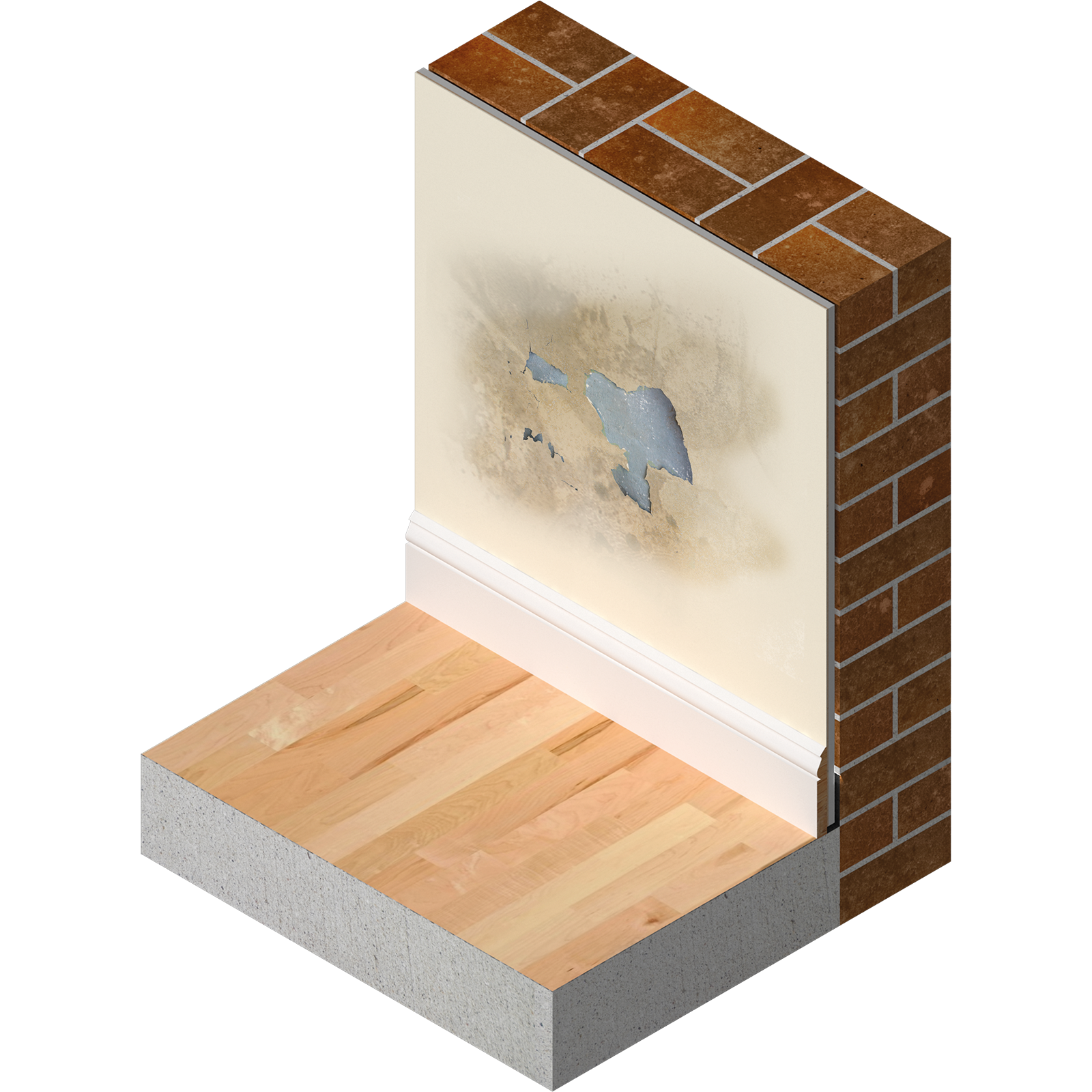
Penetrating Damp
It can be difficult to define which type of damp causes patches, mould, wallpaper and plaster damage inside the home. The key to correctly identifying penetrating damp is the height at which it manifests.
Rising damp comes up from the ground. It will never be found higher than a metre up a structure. If damp is wettest on the ground and rises to within a metre of the floor, rising damp is likely. If the damp is more than a metre high and you can’t see a ground source, it’s probably penetrating damp.
It is also important to consider the conditions around the damp home. Due to the many possibilities of the culprit behind penetrating damp, it is often more common than rising damp.
The two conditions can sometimes look similar and are often mistaken for one another. The correct diagnosis must be made before attempting to treat your home. If in doubt, the Safeguard Europe Customer Care Team is available to assist with your damp-related problem.
External Walls

- Damaged brickwork
- Moss growth
- Algae growth
- Localised damp patches
are all common symptoms of penetrating damp.
When water-soluble salts like calcium carbonate or sodium sulphate are present inside brick, they dissolve in contact with moisture. The resulting salty water travels through the brick’s capillaries to leach out of its surface. Moisture evaporates on the wall, leaving a white and powdery substance on the surface. While efflorescence itself is mostly an aesthetic problem, it is a warning sign of dampness within a wall.

If you’ve discovered efflorescence on your walls, penetrating damp may have taken hold. Water saturation damages bricks and mortar. Excess moisture pushes pressure outwards, which causes a type of damage called spalling. This refers to the flaking and crumbling that occurs on the brick’s surface.
In extreme cases, spalling can damage structural integrity. Parts of the brick and mortar fall away and become weak points in the structure. Once this kind of damage has set in, penetrating damp will only get worse. Spalled bricks and mortar let in even more moisture, causing further damage at a quicker rate.
Sunlight, minerals and water make up the recipe for algae growth. Damp exterior walls have all 3 in abundance. Although algae looks fragile, those spidery green spores are incredibly resilient. Their roots burrow deep into brickwork, taking hold within walls.
Algae roots produce acids that unbalance the alkalinity of bricks and damage them. It also damages mortar joints in much the same way.
Internal Walls

Internal signs of penetrating damp include:
- Damp patches on wall
- Black mould growth
- Wet rot, effecting wooden fixtures
Inside the home, penetrating damp wreaks havoc on plaster and plasterboard. Both types of interior finishes are porous and capable of absorbing lots of moisture.
Plasterboard swells and softens, while plaster blisters and flakes. This damage is aesthetic and structural. It weakens and damages the finish of the wall while providing the perfect conditions for mould to grow.
Damp brickwork and masonry encourage black mould growth on walls. Black mould is more common internally due to the higher temperatures needed for growth.
Black mould can grow on exterior walls too. Black mould thrives in wet, warm and humid conditions. The combination of cold weather, warm interior heating and wet walls means can cause black mould to grow alongside penetrating damp.
Black mould is harmful to the health of buildings and people. It is hard to get rid of. You must remove the invisible hyphae that exist below the substrate as well as the visible mould.
The Dryzone Mould Removal & Prevention Kit can be used to eliminate and prevent mould for up to 6 months. But that isn’t the only fungal growth that homes suffering from penetrating damp must reckon with.
Where wooden fixtures, furniture and skirting boards directly contact the damp wall, the moisture transfers through. Where fungal spores are present, this can cause wet rot. Penetrating damp causes serious damage if it reaches structural timber and will need immediate professional attention.
Cavity Walls vs Solid Walls

Insulated Solid Wall with Stormdry application and Dryrod DPC

Insulated Cavity Wall with Stormdry Masonry Cream applied
Cavity walls are common in modern house construction. Very simply, a cavity wall is a wall formed of two separate layers – one inside and one outside. The gap in between is where the wall insulation goes.
A modern cavity wall specification usually includes weep holes. These are intended to provide an exit path for moisture. These holes connect to cavity trays inside the wall, which collect and divert the moisture that penetrates the wall.
With the moisture safely diverted out of the wall, penetrating damp cannot soak through to the interior wall. Assuming the weep holes and cavity trays are installed correctly, this type of construction is effective at keeping out penetrating damp.
However, in properties that date earlier than the 1920s, solid walls are the most common type of housing construction. Exactly as it sounds, solid wall construction means that there is a single unbroken wall dividing the interior from the exterior. As brick and wood are porous materials, solid wall constructions are much more vulnerable to penetrating damp than cavity walls.
How to Prevent Penetrating Damp
The best way to ensure penetrating damp does not damage your property is to take preventative measures. Regular guttering, downpipe, roof and window maintenance will help to defend the home from dampness before it sets in. Checking renders and sealants regularly for early signs of damage also stops moisture ingress.
Regular home maintenance can help to prevent penetrating damp. Plumbing and central heating are common causes of damp within the home. Boilers must be serviced annually. Plumbing must be regularly checked to ensure that pipes are not corroded or leaking. Small leaks have been known to drip onto adjoining walls for a long time before anyone notices.
Applying a breathable waterproofing masonry cream like Stormdry Masonry Cream on the outer walls is recommended to build an effective hydrophobic barrier from moisture ingress.
Breathable Colourless Water Repellents for Masonry

Brick wall absorbing Stormdry over a period of 24 hours
Breathable, colourless [1] water repellents offer a solution in situations where there is a desire to maintain the visual appearance of the masonry. They work by lining the pores in the masonry rather than blocking them. This allows the wall to breathe naturally and allows any moisture present in the masonry substrate to escape.
Safeguard Europe produces breathable, colourless water repellents created with active silanes and siloxanes. These molecules form an extremely strong and stable bond with silicaceous building materials such as brick, mortar, concrete, and sandstone. Our deeply penetrating Stormdry Masonry Protection Cream is BBA-approved for 25 years after application.

It should be noted that products of this type are only intended to block rain penetration through the pores of the masonry. Cracks in masonry must be filled or repaired. Faulty mortar should be re-pointed using a suitable sand/cement or sand/lime mix with Stormdry Repointing Additive. This additive contains silane/siloxane water repellents to promote bonding and reduce shrinkage.
Even mortar beds that appear to be in good condition may need to be re-pointed. This is because wind-driven rain can permeate through tiny shrinkage cracks between mortar and brick or stone.
Don’t hesitate to get in touch with our technical department on 01403 210204 or submit an enquiry for further information.
[1] These products may cause some slight darkening to certain substrates. Although this will usually fade over time, a small, representative and inconspicuous test area should always be treated before full treatment begins.
How to treat Penetrating Damp internally

The most important factor in treating penetrating damp is to ensure that walls no longer allow moisture and water ingress. Black mould can be treated inside the home with biocidal sprays like Dryzone Mould Removal and Prevention Kit. However, unless the root cause is fixed, penetrating damp will reoccur. External algae, lichen and moss growth must be treated and removed before further damp treatments are carried out.
Spalled brick and mortar must be fixed and repointed to avoid extreme water ingress. Waterproof repair mortars like Drybase Universal Mortar are effective ways to fix small substrate defects. while repointing additives like the Stormdry Repointing Additive range mend and prevent further damage to mortar joints.
Saturated plaster must be stripped and replaced. Damp-proof replastering options are available to prevent plastering damage should dampness reoccur. Options include –
Damp plasterboard must be assessed for damage and mould growth, dried out if possible or replaced entirely.
In cases of penetrating damp through roofs, damaged roof tiles must be repaired or replaced. Chipped or cracked flashing or pointing must also be repaired. EPMD rubber membranes lie underneath the tiling in many modern roofs. These can disintegrate in places, allowing moisture in through the roof.
Door rain deflectors and door draft seals are two possible additions that can stop penetrating damp around doors. In these cases, exterior silicone seals around door frames must be checked and repaired. Penetrating damp around windows is a problem that can be rectified in the same way.
Some types of paint or waterproofing coating do not allow for vapour permeability. Houses need to be able to breathe to maintain healthy humidity levels. Damp which penetrates through structures that cannot breathe will remain wet. This is because moisture cannot escape the paint or waterproof coating.
How to treat Penetrating Damp externally
Breathable waterproofing creams like Stormdry Masonry Cream ensure that moisture exits the wall and maintains a water-resistant surface.
- Ensure that all leaks from water-retaining appliances like boilers and radiators have been contained and fixed.
- Leaky plumbing is a common source of non-weather-related damp.
- All standing water must be drained out of the wall & damaged areas must be dried and repaired.
- Dehumidifiers can help to dry out damp rooms once the core problem has been rectified.
Penetrating Damp Cost to Fix
The cost of treating penetrating damp depends on the size of the affected area and the severity of the problem.
- Where the problem is solely due to porous building materials, a Stormdry Masonry Protection Cream treatment may suffice.
- Repointing any wall damage will also be necessary. Cracks or movement in walls may also need to be stabilised using the Brickfix range.
- Finally, internal renovations might have to be considered, depending on the impact penetrating damp had on internal walls. There is a range of different damp-proof replastering options available, including Dryzone Renovation Plasters, Dryzone Express Replastering and Drybase Flex.
All of these extra factors can add to the overall cost of treatment and future prevention. Call us on 01403 602149 or submit an enquiry. We can help with estimating the cost of penetrating damp treatment. We can also refer you to a specialist contractor.
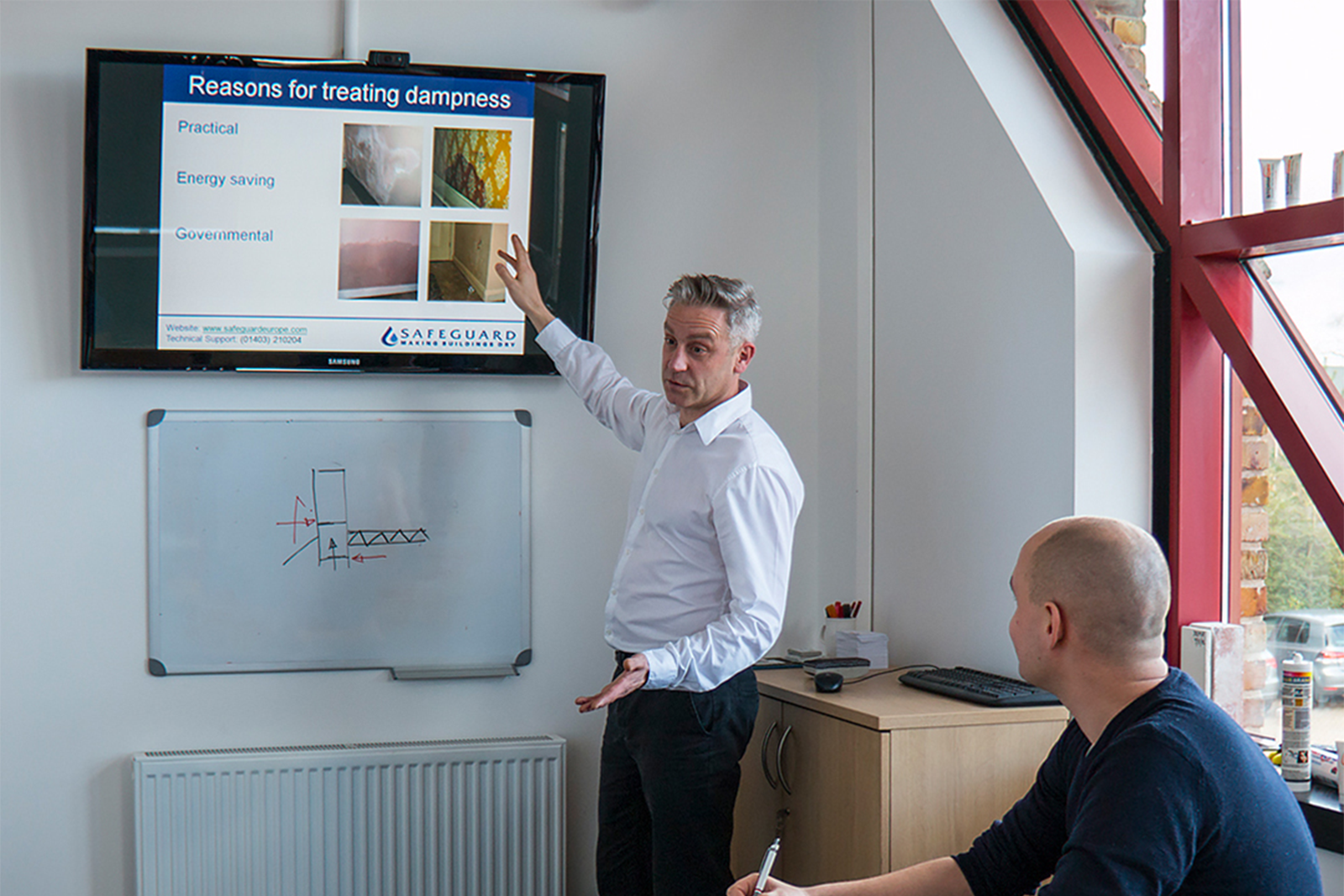
Book our free Penetrating Damp CPD Webinar
Be aware – walls can take months or even years to fully dry out. Reducing the humidity of your home and being aware of the causes of condensation will help you maintain a dry home. Check out our condensation guide.
Safeguard Europe has been battling penetrating damp since 1983. As well as an extensive range of damp-proofing products, we also have years of experience to share. Our Continuing Professional Development Webinars are approved by the Royal Institute of British Architects. Hosted by Certified Surveyors in Structural Waterproofing, Research & Development scientists and experts, get yourself fully trained up with the latest in damp-proofing methods and materials.
In our 1 hour Penetrating Damp Webinar, you’ll find out:
- Why penetrating damp is a problem
- The causes of penetrating damp
- The process of rain penetration through cavity walls
- The four-step process for treatment of penetrating damp
- Primary and secondary protection against penetrating damp
Alongside Penetrating Damp, we also offer a wide range of other building industry webinars. Discover how to deal with condensation or learn more about dampness in buildings with Safeguard Europe.